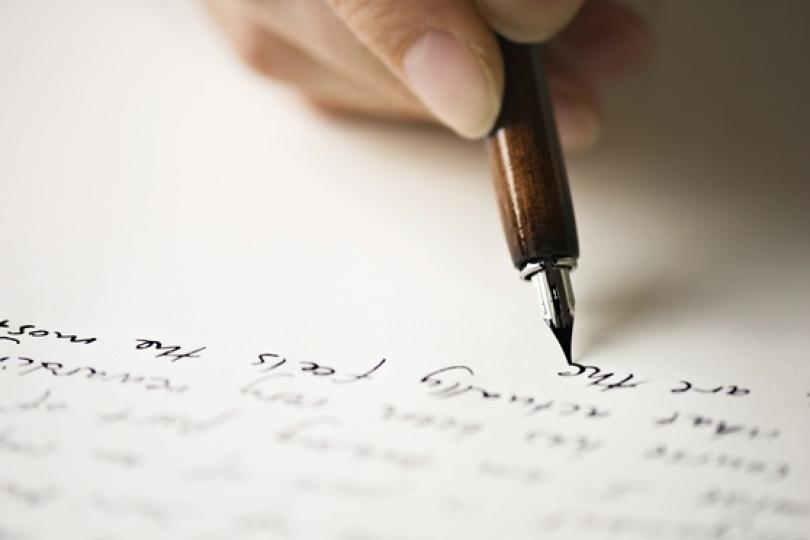
How to Write a Letter

Some months ago a young man I know texted me with his thanks for a letter I’d sent. He apologized at length for not writing back because, as he said, “No one ever taught me how to write a letter.” Feeling his plight, I took it upon myself to make an offering and sent him a polished case containing some very nice stationery and an array of colorful postage stamps, all accompanied by the following letter:

_______________________________________

A Letter need not be a novel. Nor any kind of fiction. A letter will always be your best opportunity to say precisely what you want to say in exactly the way you want to say it. Even if it’s just to say, “Hello. How are you?” Some of the most delightful letters I’ve ever received have been two or three sentences long. But even a letter so brief can be wonderful, and quite revealing of the sender’s personality. Whether offering sympathy for an injury or loss, lending reassurance during a period of turmoil, or simply to share an amusing story, a letter can do many magical things.

As people we are deeply mysterious creatures who rarely catch a glimpse of someone else’s truth. But I encourage you to embrace the act of letter writing. If you keep copies of what you write, they become pieces of your own truth that you can reassemble years from now into a clearer picture—not necessarily of who you were back then, but of the person you were in the process of becoming. We are forever evolving as people. No one ever arrives at being just one person with just one set of values. Good people, inquisitive open minded people, are always in the process of “becoming”. They take in new information all the time and are always absorbing. My father is 102-years-old and is still learning new things every day. He is one of the smartest, most decent, peaceful, and happy people I have ever known.

So please, write letters. When you read them back to yourself many years from now they will give you an amazing perspective of the journey you have taken as a person, a citizen, and as a creature of value. Any letters you receive in return can also be wonderful snapshots of the best people in your life. Most importantly though, the ability to write a good letter is something people will prize in you above all other gentlemanly traits.

HOW TO WRITE A LETTER

STEP ONE: Be Honest

Write your letters in the simplest, cleanest language you can manage. Express your thoughts on any subject that strikes your fancy. But don’t be fancy. And always be honest. My mother told me, “If you can’t say something nice about someone, then don’t say anything at all.” I noticed that when she remarked on someone not particularly pleasant, she found a way of expressing it diplomatically such as, “He wasn’t as social as one might have hoped.” or “We didn’t really get along but I’m sure she was giving it her best effort.”

When people have wronged me and I am describing what they did in a letter, I rely on diplomacy as well. If I’m discussing a third party in a letter (or in face-to-face encounters) I choose my words carefully. I pretend that if the person I’m writing about were ever to see this letter and read how I described them, they would not see me as cruel, but honest. It’s the decent thing to do, keeps me from being a gossip, and inspires me to follow my better angels. If you need to write about someone who has hurt you, by all means tell the truth. But never be mean about it.

And one more thing, if I have made a mistake or behaved badly, I am quick to admit my error and apologize. A letter is good for that too. In this day and age owning your faults is practically unheard of because nobody does that. But if you do it, you will be seen as incredibly mature. I want you to be that very rare exception—the one person people admire, respect and, most important of all, trust. We will always have the highest regard for anyone with the confidence to admit they are human. That brand of courage is in short supply these days. Saying you’re sorry is not a sign of weakness. It is a sign of consideration for others and all the very best people do it.

STEP TWO: Be Brief

Nobody likes people who ramble. Especially when they’ve nothing of substance to relate. Personally, I’ve never been comfortable speaking to people and have become expert at hiding my bashfulness. But at heart I’m still incredibly shy, feeling I hardly have anything worthwhile to say. Another trick of my mother’s was to ask questions: “If you don’t know what to say to someone, ask them about themselves. People always like to talk about themselves.” Of course the secret is to actually listen to what they’re saying. It allows you to engage and even redirect the conversation. Of course when it comes to writing a letter, this logic works by mentioning some event that’s going on and turning your narrative into a query. “I had a rough week. I’m curious what you do to take your mind off your troubles.” Or… “Nobody ever mentions my great grandparents and I sometimes wonder if maybe there’s a criminal in our family tree that no one talks about. Does your family ever discuss your ancestors?”

If you can’t think of much to say, questions are usually a safe way to proceed. At the very least, it demonstrates your interest in them. You don’t have to fill up pages and pages. Everybody (and I mean everybody) loves receiving a letter. That you took the time to sit down and lay a few kind paragraphs on paper, place it in an envelope, add a stamp, and mail it will absolutely make them feel truly valued. If they actually write back, even better.

Be prepared for most people not to write back. But don’t think that means they don’t value you too. It’s a just that a lot of folks, like yourself, believe they don’t know how to write a letter. Prove them wrong. Keep writing. We learn by doing.

STEP THREE: Be Hopeful

Finding a letter in the mailbox is almost certain to generate the biggest smile. Imagine that feeling when you receive a letter from someone else. And knowing how rarely people send actual letters, you can appreciate how an envelope with your return address on it will be cause for them to celebrate. Don’t disappoint them.

While it’s not your job to cheer up the world, and there’s no law that says a letter must only be good news, remember that people get enough bad news everywhere else in their lives. So try to remain curious about what’s going on in their life, how it’s affecting them, and if there might be a positive perspective you can offer. If there is bad news to relate, then be gentle. But for the most part, focus on hopeful conversation. And always end on an uplifting note.

So that’s it.

I know I’ve written a lot to you here. But please don’t be intimidated by all these “words”. They’re just words. You told me that no one ever taught you how to write a letter, which I love. Because it’s something you have no experience with and would like to try. We are at our most genuine when asking for help.

So now,… write me a letter.

Take a page and start at the top with the date. Dates are very important. I like to do my dates in the European fashion: Day first / Month second / Year last. It appeals to my sense of continuity with the smallest increment building to the greatest. However most Americans write the date as: Month first / Day second / Year last—perhaps because we are so used to saying it that way aloud. Use whichever feels right for you.

Next write, “Dear Michael,”.

Then write two or three or four sentences about anything at all that comes to mind. Keep it brief and upbeat. But honest. Remember, I’ll be so thrilled to have gotten a letter—which rarely happens for me—that it really won’t matter how long or short the writing is.

Next do a pleasant sign off. (“Sincerely,” or “Regards,”, or “With hopes that you are well,”.)

And finally, sign it.

Fold the letter neatly, place it in an envelope, and seal it gently. When you address the envelope be sure to print very clearly so there’s no chance they will not be able to read it at the post office. Few things are more disappointing than getting your own letter returned because it was “undeliverable” with the wrong address, or that the post office could not decipher your handwriting.

Your name and address go in the upper left corner on the front of the envelope, my name and address half way down and nicely centered, and lastly, a stamp gets securely fastened in the upper right corner.

Most home mailboxes have a red flag on the side. If yours has one you can place your letter in your mailbox and raise the red flag. When this flag is in the “up” position it tells the mail carrier that there is “outgoing” mail in the box and they will collect it, put the red flag back down, and take the letter with them to the post office. If you do not trust this method or you prefer to mail it yourself, you can deposit your letter in a public mailbox, leave it at an authorized postal center, or mail it at an official U.S. Post Office.

On a personal note, if my letter is going to someone for whom I have great affection, after I fold the finished letter, I touch my lips to it before it goes in the envelope. The recipient will never know that I enclosed a kiss. But I’ll know.

If you decide to take up letter writing trust me when I say it will be one of the most rewarding things you will do in your life. I’m proud of you and can’t wait to hear stories of your continued progress.

With very best wishes,

Michael

____________________________________

It’s been almost a year since I sent this package and I’ve yet to receive a response from him. I don’t know that I will. But then again, I never expect reciprocation for any letter I write. The joy is always in the sending. Though I do wonder if perhaps my parcel to him ought to have included a pen.

Sunday Best

In a family of ten we’d often worship in shifts and,
shuttled off on my own to early service,
I’d amble the three blocks east
down Mahantongo Street to St. Patrick’s Church.

It was obligation, not imperative, that drove me there
way back when the mass was still in Latin and,
after yet another week of parochial school,
I hadn’t the humor for one more liturgy.

Every so often, though not often enough,
at the very last moment my feet would dodge me away
from that gothic edifice and carry me farther on down
to Centre Street where all the stores were closed.

I’d meander with solitary ease, a figure of leisure,
as though indifferent to this threadbare little town.
The affectation of a grown up stride almost fueled
the impression that the manners were paying off.

And for what—the tiny thrill of a ten-year-old
blatantly blowing off God,
of gawking with guile into unlit storefronts,
of ticking away one interminably gray hour

until I could return home under the guise
of one who’d been suitably sermonized—
despite not a single break in the crease of his trousers,
as though one might have spent any time on his knees.

Here Lies a Writer

Paris.2014.ART.4795.B

A grave marker in a boneyard somewhere in the Tennessee mountains bears this engraving:

HERE LIES A WRITER… AS USUAL.

That very telling and all-too-common characterization is my favorite observation about writers. The truest quote I’ve heard attributed to a writer (don’t ask me who said it first) is this: “I hate writing—but I love having written.”

Therein resides the sum total of all obstacles to this craft—the writer’s own procrastination. Writer’s Block is a myth, an excuse bandied about by those who refuse to sit and do the work. You knock out the pages and you fix it later but you never, never, never stop writing. If you stop then you’re not a writer; you’re a slack jaw, an air biter, a bush-league bench warming bystander. In short, you’re a quitter. It ain’t tactful, what I’m saying here, and it sure ain’t kind. But it’s truthful and writers need a steady diet of truth.

It’s true that a writing life is a hard life and every time I sit down by my solitary lonesome to knock out a few paragraphs of any substance it’s a monumental struggle to come up with words that mean something to me. Every first draft is less than empty and I lean heavily on my talent and training to see me through to the deadline. I write every day, some days more than others. Using my creative muscles builds endurance and develops craft. When I finish a piece it’s not the result of a gift but rather the natural outcome of hard work.

Demanding of myself the regular output of essays is an exercise of endurance and creativity producing weekly posts and a good deal of knuckle cramping—just what I need to run my abilities through their paces. So, as regularly as I am able, I’ll be posting essays focusing on the human condition, which is my keenest area of interest.

“Here lies a writer” indeed. Lies—as in the telling of untruths. Perhaps.

.

.

.

Yet

Up ahead, through the forest, behind the mist, and beyond the darkness… is the future.

It is very much in the province of optimism to believe that whatever comes along, it will come with opportunity. It’s as natural to rely on that certainty as it is to trust that when we draw breath there will be air to fill our lungs.

We count on opportunity, otherwise we would have no reason to live. And yet…

I love the word “yet”. It is utterly aromatic with possibility. It can turn a conversation in any number of directions.

The simple use of it twists the intent of a commonplace remark toward the dark abode of disappointment or the luminous realm of noble intent. There is no tedious middle ground with “yet”. It’s a conversation turner.

Literally taken, it can mean so far, despite, up to now, eventually, or in time. While it has been employed with negative connotations, my favorite use of the word “yet” represents an optimistic outlook:

“He wrecked his car, and yet he walked away without a scratch.” Or “Healing is a matter of time, yet it can also be a matter of opportunity.”

“Yet” is no mere literary device — it is the magical moment when steel meets flint and a single microscopic spark ignites a conflagration. It introduces a turn of fortune or lends a positive spin to any situation. There’s a promise of emotion built into it. Grammatically speaking, I can think of no single syllable brimming with more promise and more hope to fuel the drama of our imaginations, which are always inspired by challenge.

Were it not for our challenges, there would be no opportunity for us to overcome them. Exceptional innovations have sprouted from the nastiest of difficulties. To me the word “yet” will always represent opportunity — the door still unopened, the adventure not quite begun.

In its best usage it can be the sunny signpost on the path to everything hopeful.

The fine Russian novelist Boris Pasternak touched on the subject most eloquently — “When a great moment knocks on the door of your life, it is often no louder than the beating of your heart, yet it is very easy to miss it.”

Too many times have I reacted to that heartbeat of opportunity with trepidation. I try to remind myself that every uplifting consequence in my life blossomed from a decision to go for love instead of fear. Fear is the scoundrel here. Always will be. How much in my life have I missed out on simply because of the fear of missing out?

“Yet” is the briefest of adverbs. A very small word. There is real power, yearning, and magic it its grasp when utilized by a master raconteur or writer.

Without the shining optimism and promise of expectation this little word adds to my work, I think it would be an effortless thing to drift into despair.

And yet, …

.

.

.

Ink

My mother was a letter writer. Mostly newsy little handwritten notes of a page or two. Her missives often included a clipping from an advice column, a positive quote, a prayer or snapshot, and a few gentle paragraphs of wit and encouragement. She always signed them, “Love, Mom.”

Image.handwritten-letter

A popular lament these days is that no one writes letters anymore. When was the last time you received one from someone close — an actual letter with stamp and postmark? Such a gift in your mailbox is stirring.

The obvious benefits of digital technology not withstanding, there’s just something remarkable in the feel of a few crisp pages in hand, along with the knowledge that considerable care and forethought went into creating them.

From my experience, an email is grabbing a hot dog from a street vendor, whereas a personal letter is a sumptuous home cooked meal. Either meets a need, but which will you savor? I don’t know anyone who sits curled up on a rainy Sunday afternoon re-reading old e-mails.

Now that Mom’s gone, on the odd weekend I’ll pour over her old letters and postcards. Some of them bearing the faint scent of her perfume or a smear of lipstick where she sealed the envelope. A letter is a tactile, tangible, aromatic entity. It’s considerably more than the essence of the person not present — a comradely whisper that redolent emotion.

I’ve tried to follow my mother’s example with mixed success. The last few years it’s become important to try writing more letters to those I hold dear. There’s much catching up to do.

In 2008 my world shifted radically. I discovered I had a 32-year-old daughter I’d never known about. When she was 13 her mother had told her about me and for the next 19 years she wondered who and where I was. When she finally found me (on the internet by the way) it was a shock and a blessing for both of us. Immediate connection, same eyes, same face, exact same sense of humor.

In the weeks before I flew from California to Kansas to meet her for the first time, I thought about what it must have been like for her all those years. For our first meeting I wanted to make a gesture that would mean something to her. I gave her a polished wooden box. With 32 birthday cards inside.

In the weeks leading up to our meeting, every day I had written cards for all the birthdays I’d missed. In each I wrote what I imagined she might have wished to hear at that time from a father. She told me that she reads them every so often and now whenever I send a new letter or card she adds it to the box.

I often think of the gift my mother left me in her writings and I take great comfort in Emily Dickenson’s assertion that a letter is a tiny piece of immortality.

While I take ease in a digital world, I find my real comfort in a simple paper letter from a friend — stamp, envelope and all. Language is the way in which we reach out, the essence of how we connect with one another. But it’s the device of our expression that defines its permanence. The fine English poet W.H. Auden struck the true center of it when he set down in ink…

“And none will hear the postman’s knock
 Without a quickening of the heart.
 For who can bear to feel himself forgotten?”

.

.

.

Fear

All the really ugly emotions are firmly rooted in fear. Fear that we won’t measure up, fear that we’ll look foolish, fear that we’ll lose success or love or respect. Prejudice is a product of fear. Anger too.

Most people, myself included, allow too many important aspects of our lives to be dictated by the anguish of embarrassment or the dread of what may or may not come to pass. So much of our self-esteem is bound up in what other people might perceive. And that is the polar opposite of healthy.

In the recovery group Co-Dependents Anonymous there’s a saying that goes, “What other people think of me is none of my business.” They have a lot of sayings but that one pretty much sums it all up.

I suspect that being the most sentient creatures on the planet, we’re instinctively bent on hubris. Humans have the biggest brain-to-body ratio so naturally we’ve got control issues. It’s that Power-and-Small-People Syndrome. Basically, as a species we think way too much of ourselves. Take for example your typical road rage. Why does it happen? One word…… Control.

You’re the good driver. You take extra pains to stay in your lane. You mostly come to complete stops, usually signal for turns and stick pretty darned close to those speed limits. Rules are there for a reason. Then another driver breaks the rules right in front of you. And why should THEY be allowed to disregard the letter of the law when you so clearly comply? That’s when the control reflex kicks in and you decide to force him to play by the rules. Of course tensions elevate and tragedy ensues.

We humans fear a lot of really stupid things that constantly land us in trouble. It’s a widely held conviction that any really important decision should never be made when one is in an elevated emotional state. Because nine times out of nine it’s not only the wrong decision but also the worst possible one.

I once read, and firmly believe, that we cannot control our emotions. But… we can control how we react to them.

Some people take issue with that and claim they have full command of all their emotions. If they truly have that power then they’re more disciplined folk than I. My experience doesn’t bear that out. My emotions suddenly arrive out of nowhere like a moth at a porch light. Where did that come from? And even though I’ve always possessed the power to choose how I react, it never really occurred to me to exercise that choice.

Once I did, I started leaning toward the path of least resistance, or rather the path of best resistance. Now when a driver cuts me off, I just stay out of his way. It’s not my job to make him obey the law. His family has to live with him, I don’t.

When I gave my daughter her first driving lesson, I told her, “You have no right — no right — to get angry at someone else in traffic. Most drivers are basically self-absorbed brain donors and when they behave badly it HAS to be what you expected. Always count on it. The only genuine surprise should be when someone actually drives courteously. That, my love, is the rarity and should be your only unanticipated event on the road.”

I give her full credit for taking that to heart. She’s a marvelous driver now and I’ve never seen her upset in the car. At least not because of other drivers.

Yes, fear is the culprit for every negative feeling we encounter. As a writer, I cope with creative fears all the time. Over the years many people who didn’t know me, and a few who did, have suggested I let go of this fruitless dream of being a writer. And there are days I actually consider it.

When you’re on your own, there’s only so much self-induced encouragement and back patting you can muster. Now, whenever taunted by self-doubt, I refer to a sign on the wall over my desk. It simply reads:

“FAILURE IS FAR LESS FRIGHTENING THAN REGRET.”

.

.

.