How to Write a Letter

Some months ago a young man I know texted me with his thanks for a letter I’d sent. He apologized at length for not writing back because, as he said, “No one ever taught me how to write a letter.” Feeling his plight, I took it upon myself to make an offering and sent him a polished case containing some very nice stationery and an array of colorful postage stamps, all accompanied by the following letter:

_______________________________________

A Letter need not be a novel. Nor any kind of fiction. A letter will always be your best opportunity to say precisely what you want to say in exactly the way you want to say it. Even if it’s just to say, “Hello. How are you?” Some of the most delightful letters I’ve ever received have been two or three sentences long. But even a letter so brief can be wonderful, and quite revealing of the sender’s personality. Whether offering sympathy for an injury or loss, lending reassurance during a period of turmoil, or simply to share an amusing story, a letter can do many magical things.

As people we are deeply mysterious creatures who rarely catch a glimpse of someone else’s truth. But I encourage you to embrace the act of letter writing. If you keep copies of what you write, they become pieces of your own truth that you can reassemble years from now into a clearer picture—not necessarily of who you were back then, but of the person you were in the process of becoming. We are forever evolving as people. No one ever arrives at being just one person with just one set of values. Good people, inquisitive open minded people, are always in the process of “becoming”. They take in new information all the time and are always absorbing. My father is 102-years-old and is still learning new things every day. He is one of the smartest, most decent, peaceful, and happy people I have ever known.

So please, write letters. When you read them back to yourself many years from now they will give you an amazing perspective of the journey you have taken as a person, a citizen, and as a creature of value. Any letters you receive in return can also be wonderful snapshots of the best people in your life. Most importantly though, the ability to write a good letter is something people will prize in you above all other gentlemanly traits.

HOW TO WRITE A LETTER

STEP ONE: Be Honest

Write your letters in the simplest, cleanest language you can manage. Express your thoughts on any subject that strikes your fancy. But don’t be fancy. And always be honest. My mother told me, “If you can’t say something nice about someone, then don’t say anything at all.” I noticed that when she remarked on someone not particularly pleasant, she found a way of expressing it diplomatically such as, “He wasn’t as social as one might have hoped.” or “We didn’t really get along but I’m sure she was giving it her best effort.”

When people have wronged me and I am describing what they did in a letter, I rely on diplomacy as well. If I’m discussing a third party in a letter (or in face-to-face encounters) I choose my words carefully. I pretend that if the person I’m writing about were ever to see this letter and read how I described them, they would not see me as cruel, but honest. It’s the decent thing to do, keeps me from being a gossip, and inspires me to follow my better angels. If you need to write about someone who has hurt you, by all means tell the truth. But never be mean about it.

And one more thing, if I have made a mistake or behaved badly, I am quick to admit my error and apologize. A letter is good for that too. In this day and age owning your faults is practically unheard of because nobody does that. But if you do it, you will be seen as incredibly mature. I want you to be that very rare exception—the one person people admire, respect and, most important of all, trust. We will always have the highest regard for anyone with the confidence to admit they are human. That brand of courage is in short supply these days. Saying you’re sorry is not a sign of weakness. It is a sign of consideration for others and all the very best people do it.

STEP TWO: Be Brief

Nobody likes people who ramble. Especially when they’ve nothing of substance to relate. Personally, I’ve never been comfortable speaking to people and have become expert at hiding my bashfulness. But at heart I’m still incredibly shy, feeling I hardly have anything worthwhile to say. Another trick of my mother’s was to ask questions: “If you don’t know what to say to someone, ask them about themselves. People always like to talk about themselves.” Of course the secret is to actually listen to what they’re saying. It allows you to engage and even redirect the conversation. Of course when it comes to writing a letter, this logic works by mentioning some event that’s going on and turning your narrative into a query. “I had a rough week. I’m curious what you do to take your mind off your troubles.” Or… “Nobody ever mentions my great grandparents and I sometimes wonder if maybe there’s a criminal in our family tree that no one talks about. Does your family ever discuss your ancestors?”

If you can’t think of much to say, questions are usually a safe way to proceed. At the very least, it demonstrates your interest in them. You don’t have to fill up pages and pages. Everybody (and I mean everybody) loves receiving a letter. That you took the time to sit down and lay a few kind paragraphs on paper, place it in an envelope, add a stamp, and mail it will absolutely make them feel truly valued. If they actually write back, even better.

Be prepared for most people not to write back. But don’t think that means they don’t value you too. It’s a just that a lot of folks, like yourself, believe they don’t know how to write a letter. Prove them wrong. Keep writing. We learn by doing.

STEP THREE: Be Hopeful

Finding a letter in the mailbox is almost certain to generate the biggest smile. Imagine that feeling when you receive a letter from someone else. And knowing how rarely people send actual letters, you can appreciate how an envelope with your return address on it will be cause for them to celebrate. Don’t disappoint them.

While it’s not your job to cheer up the world, and there’s no law that says a letter must only be good news, remember that people get enough bad news everywhere else in their lives. So try to remain curious about what’s going on in their life, how it’s affecting them, and if there might be a positive perspective you can offer. If there is bad news to relate, then be gentle. But for the most part, focus on hopeful conversation. And always end on an uplifting note.

So that’s it.

I know I’ve written a lot to you here. But please don’t be intimidated by all these “words”. They’re just words. You told me that no one ever taught you how to write a letter, which I love. Because it’s something you have no experience with and would like to try. We are at our most genuine when asking for help.

So now,… write me a letter.

Take a page and start at the top with the date. Dates are very important. I like to do my dates in the European fashion: Day first / Month second / Year last. It appeals to my sense of continuity with the smallest increment building to the greatest. However most Americans write the date as: Month first / Day second / Year last—perhaps because we are so used to saying it that way aloud. Use whichever feels right for you.

Next write, “Dear Michael,”.

Then write two or three or four sentences about anything at all that comes to mind. Keep it brief and upbeat. But honest. Remember, I’ll be so thrilled to have gotten a letter—which rarely happens for me—that it really won’t matter how long or short the writing is.

Next do a pleasant sign off. (“Sincerely,” or “Regards,”, or “With hopes that you are well,”.)

And finally, sign it.

Fold the letter neatly, place it in an envelope, and seal it gently. When you address the envelope be sure to print very clearly so there’s no chance they will not be able to read it at the post office. Few things are more disappointing than getting your own letter returned because it was “undeliverable” with the wrong address, or that the post office could not decipher your handwriting.

Your name and address go in the upper left corner on the front of the envelope, my name and address half way down and nicely centered, and lastly, a stamp gets securely fastened in the upper right corner.

Most home mailboxes have a red flag on the side. If yours has one you can place your letter in your mailbox and raise the red flag. When this flag is in the “up” position it tells the mail carrier that there is “outgoing” mail in the box and they will collect it, put the red flag back down, and take the letter with them to the post office. If you do not trust this method or you prefer to mail it yourself, you can deposit your letter in a public mailbox, leave it at an authorized postal center, or mail it at an official U.S. Post Office.

On a personal note, if my letter is going to someone for whom I have great affection, after I fold the finished letter, I touch my lips to it before it goes in the envelope. The recipient will never know that I enclosed a kiss. But I’ll know.

If you decide to take up letter writing trust me when I say it will be one of the most rewarding things you will do in your life. I’m proud of you and can’t wait to hear stories of your continued progress.

With very best wishes,

Michael

____________________________________

It’s been almost a year since I sent this package and I’ve yet to receive a response from him. I don’t know that I will. But then again, I never expect reciprocation for any letter I write. The joy is always in the sending. Though I do wonder if perhaps my parcel to him ought to have included a pen.

Sunday Best

In a family of ten we’d often worship in shifts and,
shuttled off on my own to early service,
I’d amble the three blocks east
down Mahantongo Street to St. Patrick’s Church.

It was obligation, not imperative, that drove me there
way back when the mass was still in Latin and,
after yet another week of parochial school,
I hadn’t the humor for one more liturgy.

Every so often, though not often enough,
at the very last moment my feet would dodge me away
from that gothic edifice and carry me farther on down
to Centre Street where all the stores were closed.

I’d meander with solitary ease, a figure of leisure,
as though indifferent to this threadbare little town.
The affectation of a grown up stride almost fueled
the impression that the manners were paying off.

And for what—the tiny thrill of a ten-year-old
blatantly blowing off God,
of gawking with guile into unlit storefronts,
of ticking away one interminably gray hour

until I could return home under the guise
of one who’d been suitably sermonized—
despite not a single break in the crease of his trousers,
as though one might have spent any time on his knees.

Broken

The idea that anything or anyone could be born broken relies on the conceit that the born thing must have at one time in its past been in good working order to begin with. Still the feeling that nothing worked the way it should have from the start weighs heavily on any number of people I know.

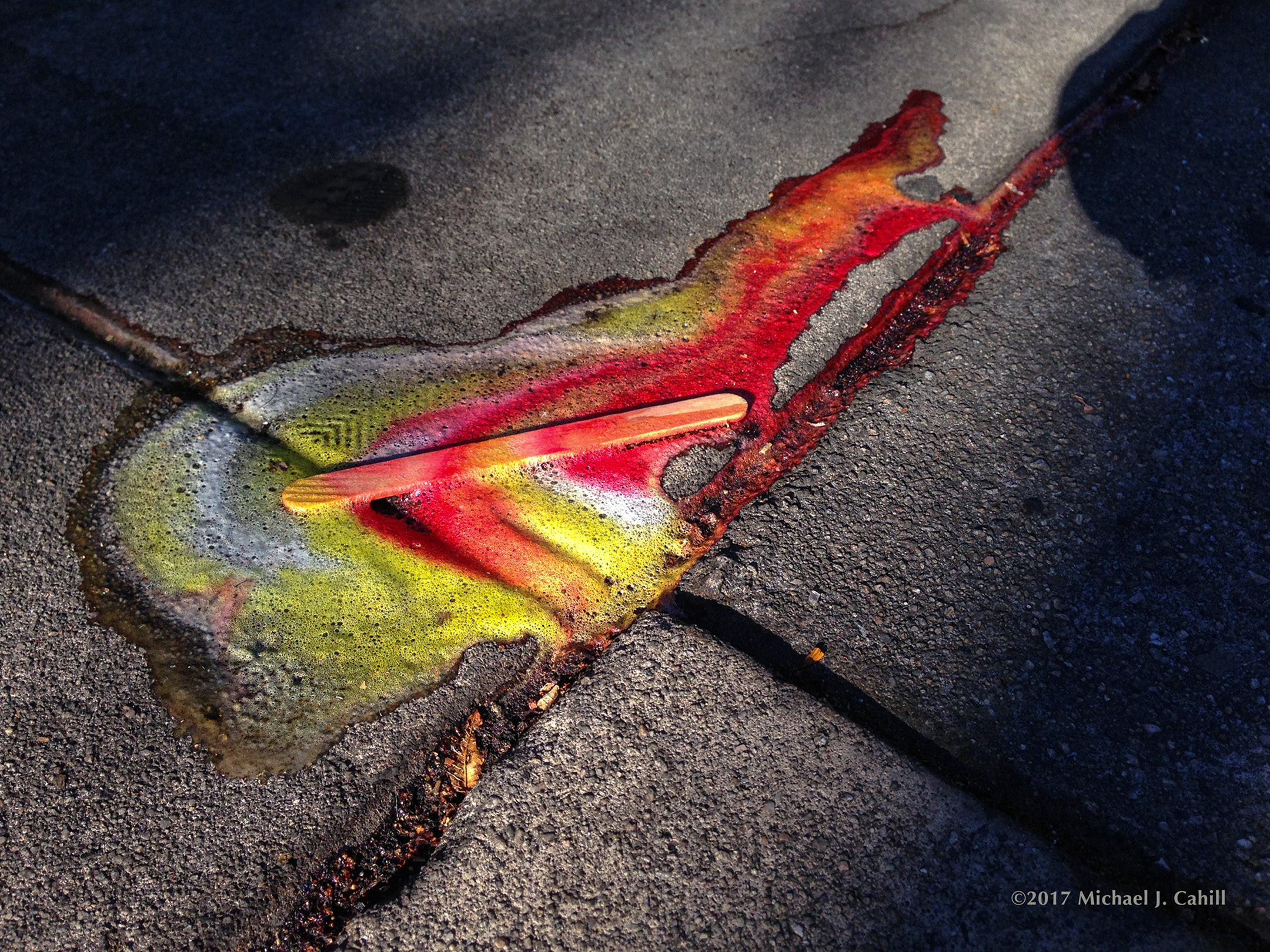
Melted.Ice.Cream.2758.A

It’s wrong in my opinion to identify with one’s damage. We are more than our broken places, more than our shattered intentions, more than deeds we couldn’t bring to life or heroes we never quite managed to become. We are far better than our shortcomings, which are so necessary to guide us in our quest to better ourselves. In this regard there are two kinds of people — those consumed by their mistakes and those inspired by them.

It is pointless to walk a mile in another man’s shoes simply to discover how he feels. If you are a true human being, walk the most difficult mile there is to walk — in your own shoes. Only then will you own every success and failure and only then will you understand the breadth of emotions that any other man feels in running that gamut. If he has done the same then he will know you as well.

I am not unsympathetic to the struggles of another. I merely realize that I must first understand the nature of struggle itself before I presume to compare mine to theirs. Unwell though we may be, and occasionally crushed and devoid of all that makes us beautiful, it is incumbent upon us to keep getting up, to keep moving forward, to leave defiant footprints in the efforts we make to grow beyond our damage. Brokenness only works to our benefit when we leave it behind.

Alchemy

It’s one of those touchstones of ancient charlatanism that has thrived beyond its medieval origins; a term that smacks of old world wizardry while holding its own in a contemporary tongue.

01.Alchemy.Graphic.01

As a precursor to the modern physician, the alchemist conjured any number of potions to ward off evil, subdue ailments and summon great fortune, and all with the wave of a wand. Ah, for the grand old days when a pharmacist could exorcise devils and regrow hair with the same elixir.

Then there’s the alchemy of affection, the essence of all that enchants, arriving readymade to seduce and satisfy. This rarified promise of handcrafted magic still intoxicates as we pine for its spell in whatever mystical form it assumes. Internet dating aside, there is something to be said for the allure of romance, the only real magic in which any of us wittingly invest ourselves. Fools that we are, oh to be subdued by beauty, ensnared by lust and shackled in the throes of love’s torturous trance.

Alchemy exists to transform a thing without value into something precious. It’s little wonder that such a seductive notion still holds sway after so many centuries. And who among us wouldn’t grasp with both hands at the thread of hope that happiness can actually be conjured from the bubbling crucibles of our most secret dreams?


NN

Grace

I know too many sad and angry souls who simply cannot bring themselves to forgive. The wounds are too fresh, too deep, too profound.

I concede that some offenses are frankly unpardonable. But when such oppressive anguish has its hooks into you so deeply, it eats away at the fabric of your wellbeing so that only one of two significant events must take place — either it will kill you, or you will kill it. A gesture of grace can be a fine weapon.

Some say they can live without forgiving someone. But holding onto such profound anxiety devastates in equal parts, mentally and physically. This pernicious decay is gradual and, though you may disguise it for a while, angst will always beat you down. That’s what angst does best.

Buddha said, “Holding onto anger is like drinking poison and expecting the other person to die.”

Absolving a cruelty or personal attack is never painless, which is why so many stay far afield of it. It’s an instinctively alien concept to actually allow someone who’s so clearly guilty to just waltz away with a Get-Out-of-Hell-Free card. But think of it rather as doing something wonderful for yourself.

In the 1970’s when I was a brakeman for the Santa Fe railroad in Wellington, Kansas there was a puppy that had lost one of its front legs to a train. It would hobble around the train yard and people remarked how sad and pathetic it was. I didn’t see that. His little face was curious and playful. Yes, he was missing a leg but he didn’t dwell on the loss. How miserable would it be to carry that kind of anguish around? Pain is not something we’re meant to hold onto.

Christ said turn the other cheek. But really think about where that came from. Imagine you’re Jesus, walking down the street on your way to give a sermon or comfort a sick soul. Suddenly a man punches you for no discernible reason. You and I would get into it with him and end up with an ambulance ride, a police report, and a fairly unflattering mugshot. But Christ knew, in the bigger scheme of things, this clown was nothing more than a distraction. Forgiveness, at its very core, is merely a difference engine.

It helps you choose — do I stop and confront my assailant, which accomplishes nothing and pulls me away from my intended goal? Or do I unceremoniously dismiss him with an “I forgive you” so I may stay on track with what’s important? There may be pain either way but which tact ends up being the lesser hurt?

Yes, there’s something definitively Christian in the concept of absolution, but at its rudimentary level, forgiving a person is really a matter of emotional economy. Do we invest our anguish in those who are undeserving of our attention in the first place? Or do we unburden ourselves of their ability to meddle with our happiness?

Terrible things will always happen to good people. And good people will always manage to navigate beyond tragedy and loss. Sometimes it takes a while, but it’s always achievable.

When I am wounded, either by circumstance or cruel intent, I remember the three-legged puppy — savaged by the world, yet determined to embrace the good that is in it. The giving of grace to another is a truly healthy act of selfishness. And it’s what I will always choose.

.

.

.

Fear

All the really ugly emotions are firmly rooted in fear. Fear that we won’t measure up, fear that we’ll look foolish, fear that we’ll lose success or love or respect. Prejudice is a product of fear. Anger too.

Most people, myself included, allow too many important aspects of our lives to be dictated by the anguish of embarrassment or the dread of what may or may not come to pass. So much of our self-esteem is bound up in what other people might perceive. And that is the polar opposite of healthy.

In the recovery group Co-Dependents Anonymous there’s a saying that goes, “What other people think of me is none of my business.” They have a lot of sayings but that one pretty much sums it all up.

I suspect that being the most sentient creatures on the planet, we’re instinctively bent on hubris. Humans have the biggest brain-to-body ratio so naturally we’ve got control issues. It’s that Power-and-Small-People Syndrome. Basically, as a species we think way too much of ourselves. Take for example your typical road rage. Why does it happen? One word…… Control.

You’re the good driver. You take extra pains to stay in your lane. You mostly come to complete stops, usually signal for turns and stick pretty darned close to those speed limits. Rules are there for a reason. Then another driver breaks the rules right in front of you. And why should THEY be allowed to disregard the letter of the law when you so clearly comply? That’s when the control reflex kicks in and you decide to force him to play by the rules. Of course tensions elevate and tragedy ensues.

We humans fear a lot of really stupid things that constantly land us in trouble. It’s a widely held conviction that any really important decision should never be made when one is in an elevated emotional state. Because nine times out of nine it’s not only the wrong decision but also the worst possible one.

I once read, and firmly believe, that we cannot control our emotions. But… we can control how we react to them.

Some people take issue with that and claim they have full command of all their emotions. If they truly have that power then they’re more disciplined folk than I. My experience doesn’t bear that out. My emotions suddenly arrive out of nowhere like a moth at a porch light. Where did that come from? And even though I’ve always possessed the power to choose how I react, it never really occurred to me to exercise that choice.

Once I did, I started leaning toward the path of least resistance, or rather the path of best resistance. Now when a driver cuts me off, I just stay out of his way. It’s not my job to make him obey the law. His family has to live with him, I don’t.

When I gave my daughter her first driving lesson, I told her, “You have no right — no right — to get angry at someone else in traffic. Most drivers are basically self-absorbed brain donors and when they behave badly it HAS to be what you expected. Always count on it. The only genuine surprise should be when someone actually drives courteously. That, my love, is the rarity and should be your only unanticipated event on the road.”

I give her full credit for taking that to heart. She’s a marvelous driver now and I’ve never seen her upset in the car. At least not because of other drivers.

Yes, fear is the culprit for every negative feeling we encounter. As a writer, I cope with creative fears all the time. Over the years many people who didn’t know me, and a few who did, have suggested I let go of this fruitless dream of being a writer. And there are days I actually consider it.

When you’re on your own, there’s only so much self-induced encouragement and back patting you can muster. Now, whenever taunted by self-doubt, I refer to a sign on the wall over my desk. It simply reads:

“FAILURE IS FAR LESS FRIGHTENING THAN REGRET.”

.

.

.

Entrancement

Some years ago a cynical friend remarked to me, “I thought I fell in love once. But it turns out I only stepped in it.”

I almost laughed. But I could see he meant it.

Eric was a really sweet guy who’d subjugated himself entirely to a willful woman. He bowed to her wants and never challenged her. He had believed that was the best way to get along with a woman. And, truth be told, I thought so too.

I grew up with five sisters and a doting mother and it was made abundantly clear that when a woman says no, she means no. My mother and father cultivated in me the traditional behaviors of opening doors, paying compliments, presenting flowers, and all the courtesies and kindnesses attendant to gentlemanly behavior.

But my dad shared an insight with me the day I left home to strike out on my own.

“Michael”, he said. “There are two things you need to know to understand women…… and nobody knows what they are.”

That time I laughed. It was only years later that I realized he meant it.

Spending a couple of decades in the same house surrounded by that much estrogen meant the man knew from whence he spoke. I still don’t know that much about women. It’s likely they’ll remain mysterious to me and, of course, that will always be part of the attraction. Romance isn’t romance without mystery.

Being a fairly even-tempered fellow, friends have had occasion to confide in me. A lot. And I’ve learned something about men from these late night laments over beer and self doubt. It turns out the same two things you need to know to understand women are the pretty much the same two things you need to know to understand men. The upshot of which is that nobody really knows anything.

I am getting better at picking up signals. I’m listening more. Especially to women. One of them recently shared that, “Yes, a woman wants a partner who isn’t afraid of tenderness. But she also wants a MAN who can stand in the fire of our emotional changes.”

That’s an intimidating way to put it. Still it brings me to a slightly higher level of understanding. But only slightly.

There’ a good deal of bob-and-weave involved in courtship. So much conflicting wisdom. And yet I persevere. I expect the fighting now, but I’m looking for a fair fighter this time. Love may be a battle. But love is also a growing up.

My parents, it turns out, were fair fighters. They enjoyed 62 years of the greatest love story anyone has every been audience to. Now that mom is gone, I recognize one more thing I learned from my father — you don’t get to really know yourself until you know yourself in a relationship. It is revelatory to see yourself in someone else’s eyes.

Victor Hugo once wrote: “The greatest happiness in life is the conviction that we are loved. Loved for our self, or rather loved in spite of ourselves.”

To be so entranced is an honorable conviction and one I deeply aspire to. To be elevated, even levitated, by a swooning rush of delight and filled with wonder and a sense of enchantment — that is the aim of the human heart. It is among our baser instincts to defy loneliness.

I believe and desire all of this. But one must also consider S.J. Perelman’s take on the matter as well:  “Love is not the dying moan of a distant violin; it’s the triumphant twang of a bedspring.”

.

.

.

Dickens

I suffer no small amount of grief from friends and acquaintances that know of my penchant for Christmas music. I’m unapologetic about it and I listen year round.

There truly aren’t enough songs out there with messages of love and peace and joy to the world. Even Mr. Scrooge eventually declared he would keep the holiday spirit all through the year. Yes, we need more unbridled affection, tolerance and generosity.

As a kid with a keen analytical mind that practically never shut down, I bought into this philosophy hook, line and tinsel. That sort of thing makes good sense when you’re seven. But even Ebenezer would testify it’s no easy task. Who wants to be around someone so relentlessly and ruthlessly cheerful every bloody day of the year? I get it.

So yes, I slide in some yuletide tunes every month or so. I’m no longer seven but I still need the fix. And it’s all the doing of that dear Mr. Dickens.

When the real holiday rolls around, I wrap myself up in the tradition of it all and am happy when I stumble upon any previously undiscovered bits of seasonal fare.

For the past several years, holidays have been relatively quiet since my family is widely distributed around the country. One of these recent Christmas mornings alone at home I turned on the television and discovered a 1938 version of “A Christmas Carol” I had never seen. Perfect!

I’m in the best of moods, all settled in for the telling of a good tale. And then it happened. My analytical mind woke up.

About ten minutes into the film I started wondering — what exactly is wrong with Tiny Tim?

Neither Mr. Dickens nor any of the film adaptations I’ve seen have ever been clear on this point.

While this very thought is building up a healthy head of steam on the hamster wheel in my mind, up on the screen Bob Cratchit comes bounding down the hall of his home with little Tiny Tim perched high on his shoulders. Really high.

And they’re headed straight for a very low doorway.

And suddenly it hits me what the kid’s malady is — Bob Cratchit is an idiot. A sweet-natured, bumbling good guy, yes. But still an idiot. Multiple and massive head trauma is surely in store for this kid, but no one else in the family ever seems to notice, especially Bob.

“Poor Tiny Tim,” they cry. “The nose bleeds and dizzy spells are getting worse. His hats no longer fit and the doctors are stumped.”

I’m trying to recapture the feeling of a holly-trimmed, pine scented Christmas of yore and my damned brain won’t turn off. Why can’t I just enjoy this?

As the film progresses, a disturbing pattern continues to develop. Consider when the Ghost of Christmas-Yet-to-Come announces, “If these things remain unchanged, Tiny Tim will not live to see another Christmas.”

Well, yeah. This kid’s not going to make it to New Years if Bob keeps smacking his little noggin into those solid oak door frames.

Later in the graveyard scene, it’s a little off-putting trying to stay with the story when I just can’t help scanning the background to see if maybe there are a few other little “Cratchit” headstones for Tiny Tim’s predecessors. Long-gone tykes like himself who suffered the same unwitting fate.

I made it through the end of the movie and of course it was all smiles and warmth and giddy camaraderie. But I couldn’t quite shake the feeling that I’d somehow been robbed of a bit more of the innocence we all hold in reserve to see us through the horrors of adulthood.

I still lament a bit for all my grown friends who heeded the call to “act your age”. In so doing, far too many among us have allowed the lessons of childhood to slip away. It’s important — in fact crucial — as an adult to remember to laugh at ourselves and to play like children. These are mandatory requirements for being a fully functional adult.

As evidence in my argument I call your attention to the main character of “A Christmas Carol”. Charles Dickens did not write this story for children. His target audience was, and is, any and every contemporary of Ebenezer Scrooge.

At any age, and at any time of year, the spirit of this wonderful philosophy supports me in my darkness and my joy.

God bless us every one…? You bet.

You’ll excuse me now while I crank up some Burl Ives and dance in my pajamas.

.

.

.

Contemplation

Contemplation is a deeply reflective word—a gentle, almost soothing assembly of syllables. You don’t rush contemplation. In fact it’s almost scripture that the word be pronounced with even tones and in the slowest and most meditative manner attainable.

Contemplation is the very kind of pastime for which languorous summer evenings were born. Your shoes in the grass, feet up in a hammock, and nothing more significant than a misty notion noodling around your noggin.

Not even an idea, mind you—just a notion.

Because a notion isn’t demanding. A notion has no outcome of any real consequence. And a notion is the fodder of a ruminating mind, all of which leads us back to… contemplation. Contemplation has oodles of hours to waste batting a notion around until tedium takes hold or the dinner bell rings.

Whereas… an idea? Well, an idea insists your brain get up off its frontal lobes and do a little legwork. An actual idea demands hard, cold calculation and ties up too much gray matter at one time. A single idea is exhausting. But a notion?

Well, with a notion you can…… do it.

Or you can…. not do it.

Or you can do it.

Or not.

And so on.

Why?

Because it’s a notion and it’s accountable to no one. And notions are why they invented contemplation. A notion is about as far down on the scale of wistful, glassy-eyed ponderings as a human mind can handle and still be functional.

Here’s an example of a notion:

Since a cat’s voice is already really, really high, wouldn’t it stand to reason that, if you feed a cat helium, its voice would then become so high that only dogs could hear it?

Okay, now that’s a notion. The kind of innocent nonsensical distraction that diverts a brain from all that makes sense in the world. Too much sense actually and far too little room for the soul to breathe.

The sad fact of the matter is that most folks can’t be bothered with contemplation. Apparently nobody with a life has that kind of time on his hands. And still I wonder what my life would be if I never took two minutes or ten hours to step outside myself and ruminate on the origins of a daffodil.

I wonder.

.

.

.

Blush

We have all been victimized by this involuntary act. And frequently at the most inopportune moments. I haven’t blushed in years. Or if I have I most certainly denied it, as all who blush are bound to do. Whatever the age, whenever it is pointed out, the armor goes up and recriminations run riot.

I did not”, you hear them cry. “It’s just hot in here!”

Yes, I’ve told that lie too, knowing all the while how ludicrous it sounds. But you stick to your guns when your dignity is so very clearly in harm’s way. You handily debase yourself without hesitation. Looking the fool is, after all, far better than owning up to even the faintest flush of authentic emotion.

The alternative of course is too grim to consider. No one in a civilized society wants a thing to do with any weasel who so obviously wears their emotions on their sleeve, let alone parades around in them like a holiday hat. Admission to a blush is tantamount to pariah status – at least that’s the internal spin we give it.

In point of fact there is a sweetness in a blush, in even the most unattractive among us. It is one of the great ironical stigmas of the modern era. A reddening of the features betrays the facade of staunch and worldly confidence that has taken decades to command. To lose one’s social footing would be horrific on so many levels. God, please don’t let it happen in a business environment!

And while I am a fan of the blush, a keen and effective reminder that a tiny breath of innocence and purity still hides in all of us, I am of two minds about it. No one contests that it has its charm. But when you fall in love at my age, it’s rather like being sea sick – you think you’re going to die but everyone else just thinks it’s funny.

The blush may be the great betrayer. But it is also one of the finer points of being truly human.

Damn it.

.

.

.